Early settlement and industry in Ringwood
Ringwood's early European development was shaped by farming, orchards, mining and land subdivision. The original village emerged in the mid to late 19th century following the sale of land in the 1850s and the growth of local grazing, fruit growing and brick making activities. Explore the people, industries and events that helped establish the township in its early years.
Orchards
For over 100 years, the major agricultural pursuit in Ringwood was orcharding. Dating from the 1860s, becoming more predominant over the following 40 years, orchards of plums, pears, apples and cherries could be found throughout Ringwood.
A Ringwood and Districts Horticultural Society was formed in 1897, not only to showcase the produce from the district but also to work toward improving methods of production and marketing.
The Ringwood Cool Stores, with capacity of 10,000 cases of fruit, were built in 1911 on the south-eastern corner of Whitehorse Road and Wantirna Road. The Cool Stores operated for nearly 50 years until they closed in 1960 and were demolished shortly after. On the site is now the Ringwood clock tower.
Other early industries within Ringwood included:
- berry growing
- flower farms
- poultry farms
- horse breeding
- mining.
Ringwood was a pioneer district and the landowners were the first Europeans to settle in the area. Some of the first families residing in the Ringwood area were Dickson, French, Kennedy, Maggs and Blood.
Some of Ringwood's earliest orchardists were members of the Blood family, whose descendants later established the Blood Brothers general store in the town centre. Learn more about the Blood Brothers general store and its heritage significance.
Learn more about the Blood Brothers general store.
Subdivision of land
Subdivisions of land around Ringwood commenced with the first sales by the Crown in the 1850s often of parcels of 640 acres, which sold at one pound per acre.
Later, more intensive subdivisions took place from the 1920s, with speculative development capitalising on the prospects of growth in the district following the electrification of the railway in 1923.
Buyers were enticed out to the land sales with free rail tickets, car transport to the land and with bands playing to create a carnival atmosphere.
Much of that newly subdivided land remained vacant - and largely unsaleable - for almost 20 years following the Depression in the 1920s to early 1930s and because of severe curtailment of residential building during the Second World War.
It was only in the year following the end of the war that demand escalated sharply for vacant land and the old orchards of Ringwood again succumbed to subdivision. Early subdivision did not offer made roads, or reticulated water, sewerage and gas. These only became common in the 1960s to 1970s. The last orchards in Ringwood fell to residential subdivisions in the mid-1990s.
Discover how Ringwood's railway line helped shape Ringwood's growth.
Mining of antimony
Mining of antimony commenced in Ringwood after its discovery in 1869.
Antimony was a sought after mineral in its time. It was used for making pewter, in the manufacture of vulcanised rubber, as pigment in paint, for the manufacture of medicines and in the printing industry. Today it is little-used and little-known.
Various mines operated generally south of Whitehorse Road and north of Mount Dandenong Road in Ringwood East, most notably Boardman's Mine in Mines Road, now the site of the Karralyka Centre. Mining took place during the 1870s and into the 1880s although was generally discontinued after 1892.
Brick works and tile works also operated in the 1880s, producing bricks and terracotta roof tiles for an expanding Melbourne. That enterprise was brought to an abrupt end by the recession of the 1890s.
The borough of Ringwood was established in 1924, which coincided with the electric railway line and subsequent development of a major township.
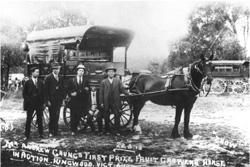
Image caption: Ringwood’s orchard industry flourished from the 1860s, with fruit growing remaining a major part of the district’s identity for over 100 years.
Image caption: The subdivision of land throughout the early to mid-20th century helped shape Ringwood’s transition from a rural orchard district to a developing suburb.
Continue exploring Maroondah's history
Related Ringwood pages
Other local history