Maroondah Coat of Arms
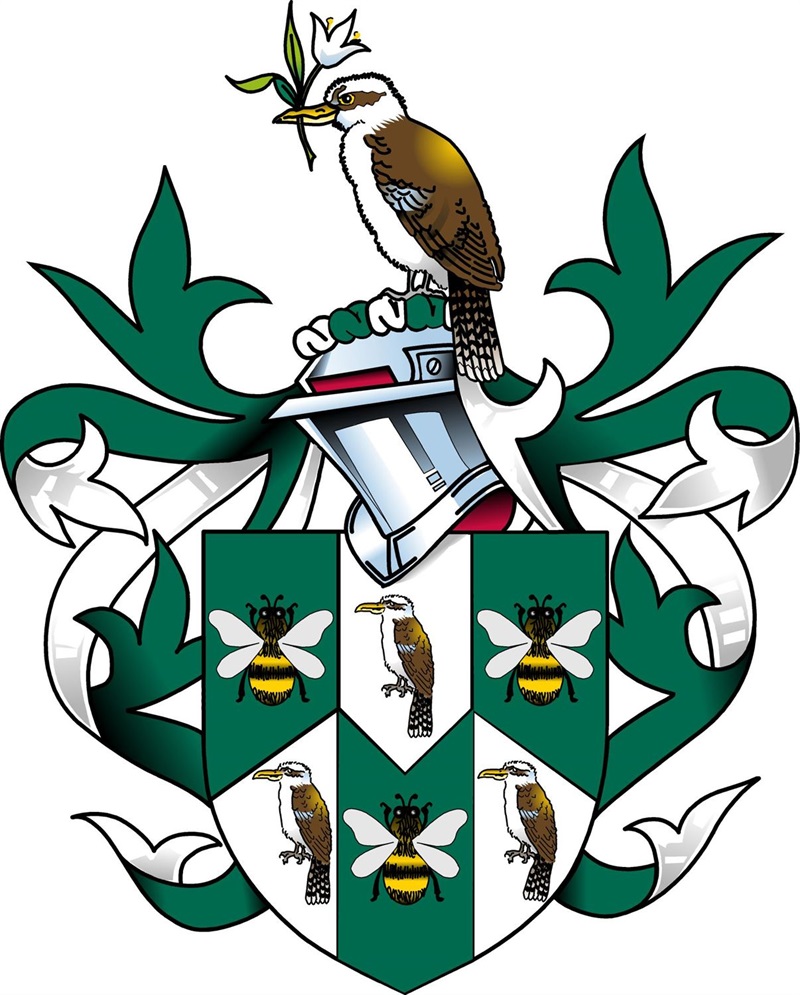
The Garter Principal King of Arms, London, granted the City of Maroondah its Coat of Arms on 6 April 1999
The Coat of Arms reflects the historical links and common origins of the areas now incorporated within Maroondah.
Ringwood and Croydon have a common origin in that they originally formed part of the Shire of Lilydale – the area which formed the Borough of Ringwood severing ties in 1924 and the Shire of Croydon being created in May 1961.
Therefore, in choosing emblems to appear on Maroondah’s Coat of Arms, care was taken to include symbols, which had meaning to residents of both the former Cities of Ringwood and Croydon.
The lily in the beak of the kookaburra perched on the helmet above the shield signifies the severance of these areas from the Shire of Lilydale.
The quarters on the shield are green and white: green for the beauty of the trees of which Maroondah is justifiably proud, white to perpetuate the early name “White Flats”, coined by pioneering settlers on observing the many white flowering plants which covered much of the area.
Both former Cities had an orchard/farming background, hence the bees representing industriousness and agriculture, incorporated in the shield.
Croydon adopted the Cornish Chough (which resembled a bird which inhabited Croydon, Victoria, in the early days) as part of its Coat of Arms to demonstrate its affinity with Croydon, England. For the same reason, the Borough of Ringwood depicted kookaburras on its Crest as they were considered to be similar to the blackbirds, which appear on the Crest of Ringwood, England.
Maroondah has perpetuated the use of the kookaburra in its Coat of Arms, placing it in the same position in which the Chough appeared in the Croydon Coat of Arms. The kookaburra is perched upon what is called the “fountain” in heraldic terms and is a knight’s helmet from a suit of armour and is generic to almost all Coat of Arms. It provides a link to the very embryonic root of Coat of Arms when they served to identify medieval knights (from friend or foe) within the heat of battle. Various meanings are ascribed to the view of the helmet either front or side on and to whether the visor is open or closed. Maroondah’s is designed as a Coat of Arms for a company.
Croydon City Coat of Arms
Croydon’s Coat of Arms was used from September 1968 until amalgamation in December 1994.
An application for a Coat of Arms was made by the Shire of Croydon to the College of Arms in London on 23 September 1966.
A Coat of Arms was subsequently formally granted to the Shire on 30 September 1968.
Upon Croydon becoming a City in May 1971 the Coat of Arms could still be utilised, as the City was the Shire’s natural legal successor.
To reflect the affinity between Croydon in England and Croydon in Victoria two components were replicated from the English Croydon’s Coat of Arms. The fountain (knight’s helmet) and also the Cornish Chough (a crow like bird).
The Chough being native to both England and Australia – it inhabited Croydon Victoria during the areas early settlement.
Other components of the Coat of Arms are:
- The lily in the beak of the Chough signifies the origin of Croydon in that it once was part of the Shire of Lillydale.
- The quarters on the shield are green and white. Green for the beauty of the trees and white to perpetuate the early name of Croydon – “White Flats”.
- The bee is the symbol of industriousness. The sprigs of apple indicate the early origins as a predominantly fruit growing area. The apple representing the past, the bee the present and future.
- The motto on the Coat of Arms is Beholding Continued Progress.
In 1988 the theme The Natural Choice was adopted by Council and used in conjunction with the Coat of Arms.
Croydon being The Natural Choice to raise a family, conduct business and to enjoy leisure time.
Ringwood Borough and City Crest


Instead of using a formal Coat of Arms, Ringwood adopted home grown versions that became known as 'crests'.
The Borough Crest was used from 1925 until 1960 when Ringwood was proclaimed a City. After that date a City Crest was then used until amalgamation in December 1994.
It was only in 1993 that Ringwood adopted a logo – featuring the Clock Tower, a bird, parkland and the Lake. It lasted just on 12 months until amalgamation in December 1994.
The borough crest adopted in 1925 was very similar to the Coat of Arms of the English town of Ringwood, with one major exception in that Kookaburras replaced the English Blackbirds.
The Latin motto Procredere Ne Regredere means Forward Not Backward.
The City Crest was devised by Councillor Robert Horman in 1960. Quite a degree of licence was taken with the end design as it only adhered to some of the rules of heraldry.
The shield is divided by a fess dancette - zig zag lines which run horizontally. This in turn is divided by 4 lines into 3 equal spaces known as barruletes . These represent the three wards of Ringwood. It had had 3 peaks representing the virtues within the community – truth, beauty and goodness.
The devices on the shield were:
- a kookaburra – retained as an essential link to the borough (denoting progress by its beauty, speed, courage and strength)
- a sprig of wattle – denoting the pride of home owners in their gardens, parks and streets
- a tree - denoting growth, natural resources and progress rooted in unity.
At the top of the shield is a wreath that supports:
- an antique crown
- a plain circle of Or (gold) representing the rising sun.