Primary school waste education
Council provides a range of helpful waste education resources and programs for schools in Maroondah.
On this page
School incursions
Council provides a range of free waste education incursions for primary schools within Maroondah.
Schools can book one incursion day per calendar year. Providers will consult with your team to ensure that the sessions are unique to your students’ needs.
Download incursions brochure(PDF, 999KB)
Incursions options
Eco Coder - suitable for Years 3 to 6
Students explore how robots are now being used to help us recycle more efficiently. They will have a go at coding the BeeHealthy robots to ensure they take the appropriate waste to the correct recycling bin.
Facilitator: Bee Healthy Stories
Monster Bins - suitable for Years Foundation to 4
Students feed the monster bins who are very fussy eaters. They learn about contamination and the problems it is causing with recycling. Students take action to help their school reduce contamination in their bins.
Facilitator: Bee Healthy Stories
Plastic Pollution - suitable for Years Foundation to 2
Students explore the different ways we can recycle in Maroondah. They learn about plastic pollution and what they can do to help.
Facilitator: Bee Healthy Stories
Textile Waste - suitable for Years 2 to 4
Students learn about the lifespan of waste and the fun ways we can recycle. They then upcycle textile waste into new items.
Facilitator: Bee Healthy Stories
The lifecycle of Everyday Objects - suitable for Years 5 to 6
Students often see objects as things to be used and discarded, but what if we could give them a new continuity of life? This program explores the journey of everyday items and their sum of parts up to packaging, such as plastic bottles, clothing, electronics, and food.
Facilitator: Cirque du Soil
Circular Economy in Action - suitable for Years 5 to 6
This hands-on incursion offers a deep dive into the circular economy through hands-on activities that make the concept tangible and relatable.
Option one - Students will engage in upcycling and resource management tasks that demonstrate how waste can be transformed into valuable resources, fostering creativity and problem-solving skills.
Option two - Students will engage in creating their own micro-recycling stations using upcycling of local waste resources and participate in group games of “waste-ketball” that demonstrate linear vs circularity.
Facilitator: Cirque du Soil
Book an incursion
Submit a booking enquiry form to discuss an incursion at your primary or secondary school.
Submit booking enquiry
Please email waste.education@maroondah.vic.gov.au if you have any other school requests or enquiries.
Hire kits
Council has two hire kits suited for years foundation to two:
- Composting and Worm Farms
- Recycling and Bins
Each kit contains a selection of picture books, hands on activities, handouts and ideas for younger learners.
Submit booking enquiry
Waste audit hire kit
The waste audit hire kit helps schools carry out a waste or litter audit. This information can be used when completing the ResourceSmart waste module.
The kit contains a guidebook, tubs and equipment to sort the waste, scales, worksheets, follow up activities and more.
Submit booking enquiry
Put a grin on your recycling bin game
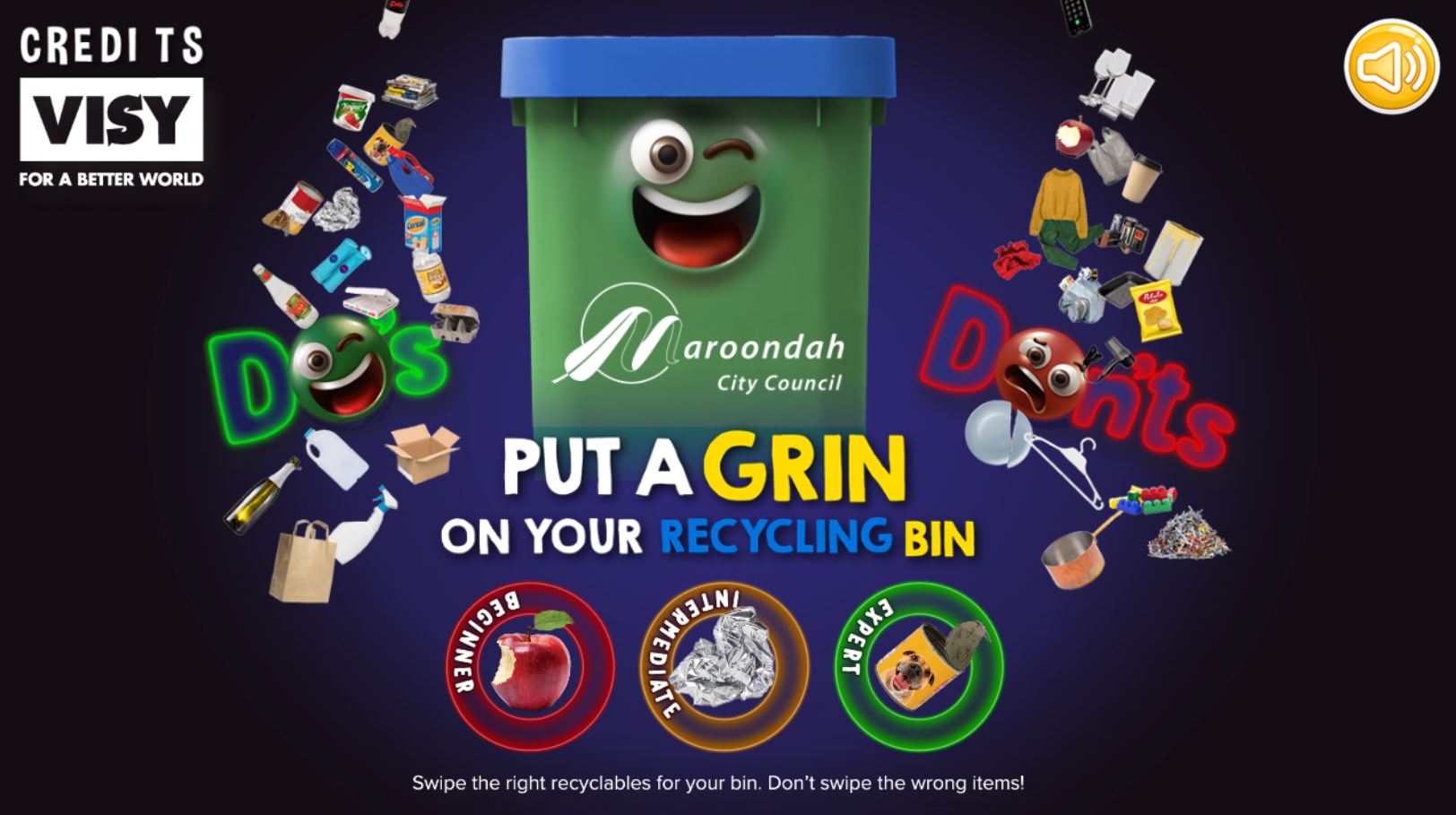
Swipe across the recyclables to put them in your recycle bin. Try not to swipe on non-recyclable items.
Choose a difficulty level below and get ready to swipe!
Put a grin on your recycling bin
Professional development and parent education sessions
All Maroondah based educational settings are eligible to receive professional development for staff or a parent education session with Council’s Waste Education team to assist on waste reduction or waste management.
Potential topics include:
- Composting
- Reducing food waste and nude food
- Understanding waste and bins
- Recycling and hard to recycle items
- Evaluating and advising on waste management plans.
For more information, please email waste.education@maroondah.vic.gov.au.
Waste reduction initiatives
Resources and lesson plans
Bins
Signage
Bin signage - A4(PDF, 1MB)
Bin signage - 260 by 200(PDF, 1MB)
Colouring sheets
Batteries(PDF, 831KB)
Circular economy(PDF, 459KB)
Linear economy(PDF, 386KB)
FOGO bin to compost(PDF, 386KB)
FOGO bin contents - with ticks(PDF, 118KB)
FOGO bin contents - no ticks(PDF, 115KB)
General rubbish bin contents - with ticks(PDF, 133KB)
General rubbish bin contents - no ticks(PDF, 133KB)
Keep your recycling loose(PDF, 298KB)
Mixed recycling bin contents - with ticks(PDF, 144KB)
Mixed recycling bin contents - no ticks(PDF, 144KB)
Lessons plans
- Exploring Closed Loop Recycling (Years Foundation to Two)
Students investigate the composition of objects, the purpose of different bins for waste and recyclables, and the closed-loop recycling process.
- War on Waste - Waste Management (Years Foundation to Four)
Students explore waste management topics such as waste categorisation, plastic waste, single-use plastics, waste decomposition, and school waste disposal systems.
- National Recycling Week: Recycling and Waste Reduction (Years Foundation to Six)
Students explore recycling and waste reduction topics such as the Australasian Recycling Labels and their purpose, the recycling loop for various products, and the difference between renewable and non-renewable resources.
- Clean Up Australia Day: Let’s Talk Trash (Years Foundation to Six)
Students are equipped with the skills and confidence to make informed, sustainable choices, actively contributing to a cleaner environment at school and beyond.
- War on Waste: The Environmental impacts of Waste (Years Three to Six)
Students explore topics such as waste disposal methods, the impact of waste on the environment, and actions that individuals and households can take to address waste issues.
- Upcycling Cardboard (Years Five and Six)
Students use Design Thinking principles to find sustainable solutions for Australia’s recyclables, helping to reduce material sent to landfill.
- Understanding Recycling Labels (Years Five and Six)
Students learn about the Australasian Recycling Label (ARL) and how individuals can make a positive impact on the environment by changing their recycling behaviour and consumer habits.